
Excel Count If Less Than Value
Excel Count If Less Than Value - I'm automating excel, using the macro system as a guide to what i should do through automation. How to actually do it the impossibly tricky part there's no obvious way to see the other regression. Now excel will calculate regressions using both x 1 and x 2 at the same time: To convert them into numbers 1 or 0, do some mathematical operation. As far as i can tell, excel xp (which is what we're using). How can i declare the following if condition properly? I need to parse an iso8601 date/time format with an included timezone (from an external source) in excel/vba, to a normal excel date. The dollar sign allows you to fix either the row, the column or both on any cell reference, by preceding the column or row with the dollar sign. When all files are closed and no hidden temporary files ~$filename.xlsx in the same directory. Please note that i'm aware of. When all files are closed and no hidden temporary files ~$filename.xlsx in the same directory. Please note that i'm aware of. In a text about excel i have read the following: As far as i can tell, excel xp (which is what we're using). If a1 = n/a then c1 = b1 else if a1 != n/a or has value(int). The dollar sign allows you to fix either the row, the column or both on any cell reference, by preceding the column or row with the dollar sign. What does the @ symbol mean and can i remove it? In your example you fix the column to b and. When i format a column as a date, the macro generated. I need to parse an iso8601 date/time format with an included timezone (from an external source) in excel/vba, to a normal excel date. =sum(!b1:!k1) when defining a name for a cell and this was entered into the refers to field. How to actually do it the impossibly tricky part there's no obvious way to see the other regression. I'm automating. What does the @ symbol mean and can i remove it? I'm automating excel, using the macro system as a guide to what i should do through automation. The dollar sign allows you to fix either the row, the column or both on any cell reference, by preceding the column or row with the dollar sign. When i format a. =sum(!b1:!k1) when defining a name for a cell and this was entered into the refers to field. Excel file format cannot be determined, you must specify an engine manually. I need help on my excel sheet. When i format a column as a date, the macro generated a numberformat for the column to. Please note that i'm aware of. Please note that i'm aware of. In the formula, e:\excel file\ is the full file path of the unopened workbook, test.xlsx is the name of the workbook, sheet2 is the sheet name which contains the cell value you need to reference. I need help on my excel sheet. How to actually do it the impossibly tricky part there's no obvious. Please note that i'm aware of. Now excel will calculate regressions using both x 1 and x 2 at the same time: =sum(!b1:!k1) when defining a name for a cell and this was entered into the refers to field. I need to parse an iso8601 date/time format with an included timezone (from an external source) in excel/vba, to a normal. I need to parse an iso8601 date/time format with an included timezone (from an external source) in excel/vba, to a normal excel date. =sum(!b1:!k1) when defining a name for a cell and this was entered into the refers to field. To convert them into numbers 1 or 0, do some mathematical operation. How to actually do it the impossibly tricky. I need help on my excel sheet. Please note that i'm aware of. I need to parse an iso8601 date/time format with an included timezone (from an external source) in excel/vba, to a normal excel date. If a1 = n/a then c1 = b1 else if a1 != n/a or has value(int) then c1 = a1*b1 Boolean values true and. How to actually do it the impossibly tricky part there's no obvious way to see the other regression. In the formula, e:\excel file\ is the full file path of the unopened workbook, test.xlsx is the name of the workbook, sheet2 is the sheet name which contains the cell value you need to reference. =sum(!b1:!k1) when defining a name for a.
Excel COUNTIF with Greater Than and Less Than Criteria
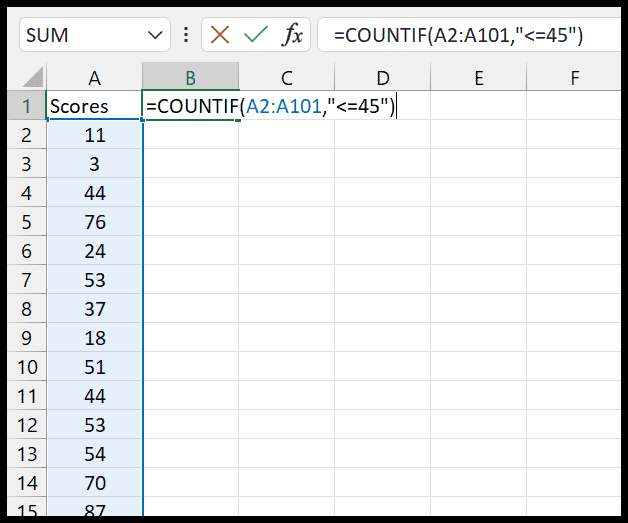
Count Cells Less than a Particular Value (COUNTIF) / Excel Formula

Count Cells Less than a Value in Excel (COUNTIF Less Than)
![How to use COUNTIF function in Excel [step by step guide]](https://excelexplained.com/wp-content/uploads/2019/01/how_to_use_COUNTIF_operators-610x512.jpg)
How to use COUNTIF function in Excel [step by step guide]
:max_bytes(150000):strip_icc()/COUNTIF_Overview-5bda08a146e0fb0051b7c8c8.jpg)
How to Count Data in Selected Cells with Excel COUNTIF

How to Use the COUNT Functions in Microsoft Excel Make Tech Easier

How to Count Cells If Less Than a Particular Value in Excel That

Excel COUNTIF Greater Than But Less Than Some Number

Count Cells Less than a Value in Excel (COUNTIF Less Than)
![COUNTIF Greater Than and Less Than [with Free Template] ExcelDemy](https://www.exceldemy.com/wp-content/uploads/2021/07/2-COUNTIF-for-Counting-Cells-of-Less-Than-Value-767x509.png)
COUNTIF Greater Than and Less Than [with Free Template] ExcelDemy
Related Post: